Welcome to FreeGuitarCourse.com!
For Sitemap click the underlined FreeGuitarCourse.com logo above.
Join our free newsletter for site updates, tips, & tricks!
Major Pentatonic Scale Patterns for Guitar
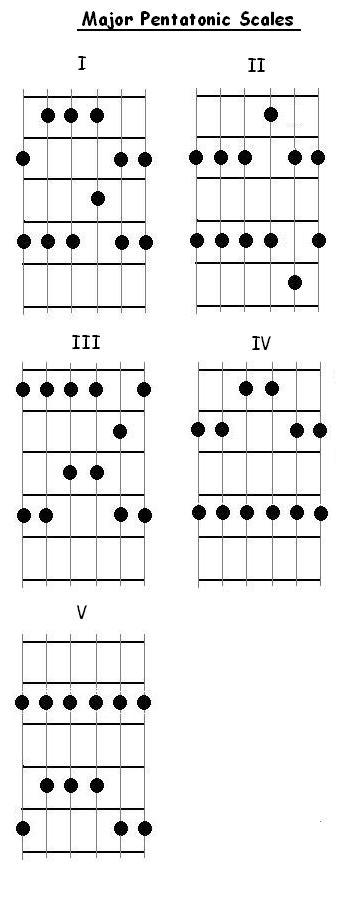
Let's look now at some more very useful scales. If you have been around other more accomplished guitar players you may have heard of the Major Pentatonic scales. We get the name from the fact that we derive these scale patterns from five notes, rather than the seven notes of the diatonic major scale patterns (diatonic refers to the two types of steps, half step and whole step, found in these scale patterns).
The pentatonic scales come in two flavors, major and minor. As you may suspect, the major pentatonic scale patterns work well over major sounding chord progressions. You will find that the major pentatonics are very popular in country music and Southern rock. They also work well over many pop songs, contemporary Christian songs, and blues progressions (dominant chord based progressions).<
As with the major scale patterns, you will need to practice these patterns as often and long as possible. They are very versatile scale patterns, even more so than the major scale patterns. You will hardly find a song in popular music that you can't play an improvised solo over using one or the other of these scale patterns or their minor pentatonic counterparts.
Notice that the lower notes of pattern two and upper notes of pattern one (lower and upper in reference to pitch range, not the computer screen!) are the same notes. The upper notes of pattern two are the lower notes of pattern three, etc. The upper notes of pattern five are the lower notes of pattern one, so that the whole set of five patterns repeats itself at some point on the fretboard, depending on what key you are playing in. You may remember this also happened with the major scales, and it will be the same with all scale pattern types, five forms and then a repeat. Again, this means you can move from one pattern into another and still be playing the major pentatonic sound, which adds a lot of creative options to your solos. For beginning purposes, play the first note of pattern one on a note that corresponds to the key you wish to play in. For instance, if you want to play in the key of A, start the first note of pattern one at the sixth string, 5th fret. As long as you follow the pattern you will automatically be in the key of A. The pattern does the hard mental work for you. You will have enough work on the physical end, so take advantage of the ease of the patterns!
Sponsors