Welcome to FreeGuitarCourse.com!
For Sitemap click the underlined FreeGuitarCourse.com logo above.
Join our free newsletter for site updates, tips, & tricks!
Introduction to Seventh Chords
OK, now we want to expand our chord vocabulary a bit. We are going to look at some specific chords, but we also want you to understand how the chords are built, so you can figure out the ones we do not show here, and so you will better understand how they fit into progressions of other kinds of chords.
Now, remember from our discussion of triads that we build chords, in the most basic understanding of the concept, from odd number intervals of the key we are building the chord from. So for a major triadic chord, by definition, we want to select the first, third, and fifth intervals. We are going to continue with this same concept and extend it to include the seventh interval note.
For simplicity we will start with a C Major Seventh, since the C major scale has no sharps or flats. So according to the interval relationships we learned previously, the notes of the C major chord are C, E, and G. Now, in accordance with the name of this chord we are building, Major Seventh, we are going to add the seventh interval note for a four-note chord. The new extra note will be a B note. So here is what our new chord looks like.
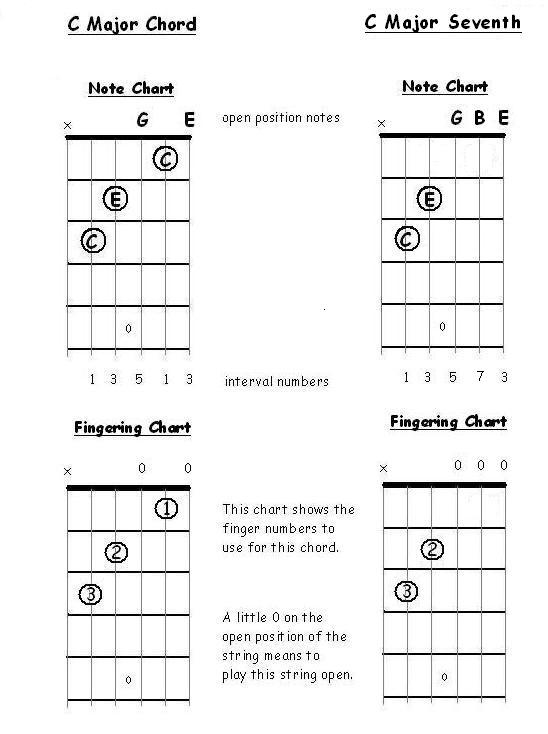
You will see this chord type labeled in various ways:
CM7, Cmaj7, C 7.
7.
Now let's take a look at the Dominant Seventh Chord. You will see this chord often in blues style songs, and it shows up in other types of common chord progressions as well. It has a tense sound. We construct this chord type by adding the seventh interval note, as the name implies, but also flatting this seventh note by one half step. So in the case of our C Major Seventh Chord above, we want to change the B note to a Bb (B flat).
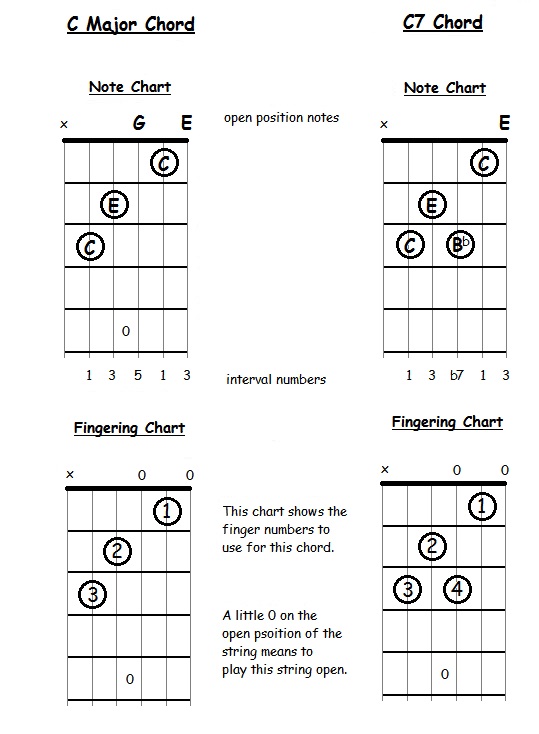
You may find this fingering hard to master at first. Keep working on it and you will get it.
You may have noticed that we dropped the fifth interval note completely out of the chord and replaced it with our new Bb note. As chords get more complex we find that we simply do not have enough fingers, and strings in many cases, to include all the notes that should be in a chord by definition. In these cases we want to include as many notes as we can, and we emphasize choosing notes that heavily influence the overall sound of the chord. In the case of our Dominant Seventh chord the fifth interval note does not make a significant impact on the overall sound, so we drop it in favor of the flat seventh note, which does make a major difference in the overall sound.
This chord type can add a bit of useful tension when used as the V chord in a I-IV-V progression. It is also a great chord type to use for I, IV, and V if you want to play a blues style song. Below is a chart containing the Dominant Seventh Chords in the open position. We will look at some alternate fingerings of these useful chords further in the Advanced section of the course.

Sponsors