Welcome to FreeGuitarCourse.com!
For Sitemap click the underlined FreeGuitarCourse.com logo above.
Join our free newsletter for site updates, tips, & tricks!
Triad Chord Construction for Guitar
Ok, we now have a major scale pattern and a chord progression to keep you busy, let’s move on to some more chords. Triad Chord Construction sounds complicated, doesn’t it? Would you believe we have already covered this? Well, we have, we just didn’t hang that scary label on it. Our first three chords, C, F, and G major are triad chords. Triad refers to the fact that these chords are built out of three notes. Remember, we showed that C, F, and G Major are built out of the first, third, and fifth intervals of their respective scales. We will be looking at some more complex chord constructions later. For now we need to consider the rest of the major chords.
The remainder of the major triads are built in the same fashion, using the first, third, and fifth interval notes. So lets’ look at the A major scale for a moment, then we can build the A major chord.
A Major Scale : A-B-C#-D-E-F#-G#-A
Notice all the sharps. Remember, we are not looking at the A scale, but the A MAJOR scale, which starts with A and follows the step arrangement that yields the major sound: w-w-h-w-w-w-h. Now remember, no sharps and flats bewteen B and C, so a whole step from B yields a C#. See how this works? So if we want to build an A Major chord, we need to sound out with an A (first interval), C# (3), and E (5). Let’s build this chord in the open position.
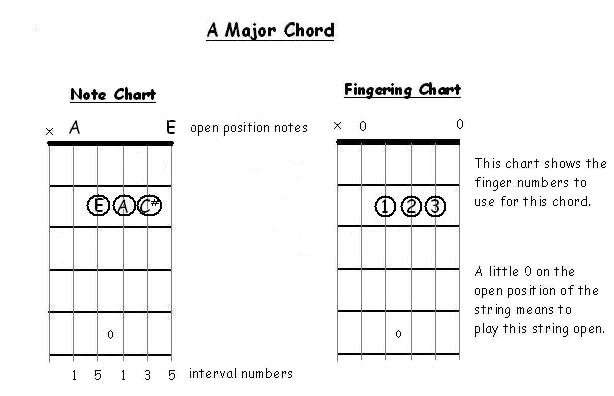
The rest of the major chords are here for your reference. We recommend you take the time to label them all yourself with notes and intervals, it will really help you understand things when we get to the basic moveable chord patterns, of which we have already looked at all five! We will explain that later, for now just memorize these major chords in the open position. Go ahead and start working with strumming them, concentrating on ringing out all the notes clearly. You won't be able to do it on the first try, just keep working on it and it will come to you. In the coming pages we will be looking at how to arrange the chords in progressions that sound satisfying. For now, just work on mastering the chords.
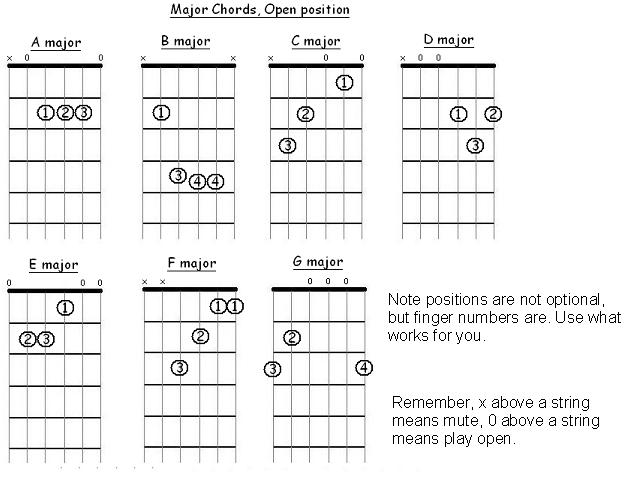
If you have understood all we have covered so far then you are ready to move on to the Minor Triads.
Sponsors